 review
Buy Wireless Charging Pads Online: Best Picks for 2026
Table of Contents
- What to Know Before You Buy Wireless Charging Pads Online
- Wireless Charging Pad Reviews: How We Evaluated Each Model
- Best Wireless Charger for iPhone: MagSafe and Magnetic Alignment Options
- Fast Wireless Charging Pad Picks for Android and Multi-Device Users
- Wireless Charging Stand vs. Pad vs. Mount: Which Design Fits Your Desk
- Long-Term Battery Health, Safety Features, and Eco-Friendly Materials
- Desk Setup Integration, Cable Management, and Troubleshooting Charging Failures
- Where to Buy Wireless Charging Pads Online: What Sets a Good Retailer Apart
Last Updated: August 1, 2026
Deciding to buy wireless charging pads online is straightforward until you realize how many incompatible standards, misleading wattage claims, and poorly designed products compete for your attention. At Esther Tech Shop, we've curated wireless charging solutions that match the needs of home office professionals, multi-device users, and anyone serious about reducing cable clutter. Below, we'll show you how to evaluate each option, which design fits your desk, and what to watch out for before you spend a dollar.
Here's what most buying guides get wrong: they treat all wireless charging pads as interchangeable. The gap between a Qi-certified pad and an uncertified one can mean the difference between 15W fast wireless charging and a slow, unreliable trickle that damages your battery over months.
What to Know Before You Buy Wireless Charging Pads Online
Wireless charging is the transfer of power between a charging coil inside a pad and a receiver coil inside your device, using electromagnetic field induction. The technology works across smartphones, earbuds, and smartwatches, but only when the device and pad share a compatible standard.
The most important decision before purchasing is understanding which standard your devices support. Getting this wrong means buying a pad that charges at a fraction of its rated speed, or one that won't charge your device at all.
Qi and Qi2 Standards: Why Certification Matters
Qi is the foundational wireless charging standard developed by the Wireless Power Consortium, and nearly every wireless charging device sold in the US today carries Qi compatibility. Qi2, introduced in 2023, adds magnetic alignment and raises baseline charging efficiency for compatible devices.
Qi-certified products have passed independent testing for safety and interoperability. Uncertified alternatives may advertise the same wattage but lack over-voltage protection, foreign object detection, and thermal protection, all required under Qi certification. According to Wireless Power Consortium's Qi certification requirements, certified products must pass rigorous safety and performance testing before bearing the Qi logo.
A Qi2 pad with magnetic alignment ensures your device sits over the charging coil precisely every time, eliminating the frustrating "it charged 12% overnight" problem caused by misalignment.
Charging Speed and Wattage: 15W, 25W, and What Your Device Actually Uses
Wattage output determines charging speed, but your device's receiver sets the ceiling. An iPhone 15 Pro tops out at 15W with MagSafe. Many Android flagships accept 15W or higher over Qi.
The 25W figures you see on some Android-compatible pads require specific device support. Buying a 25W pad for a device that caps at 10W won't hurt anything, but you won't see any speed benefit. Match the pad's wattage to your device's maximum supported wattage for the best result.
USB-C power delivery from the wall adapter also matters. Many pads ship without an adapter, and plugging a 15W pad into a 5W USB-A brick will throttle charging speed significantly. Always check whether a power adapter is included.
Wireless Charging Pad Reviews: How We Evaluated Each Model
Every wireless charging pad recommendation in this guide was assessed against four criteria: charging speed under real conditions, device alignment reliability, thermal behavior during extended sessions, and build quality relative to price. We prioritized Qi-certified and Qi2-certified products exclusively.
Our Scoring Criteria at a Glance
| Criterion | What We Tested | Why It Matters |
|---|---|---|
| Charging speed | Actual wattage delivered vs. rated | Rated speeds are often peak, not sustained |
| Alignment reliability | Charge success rate without repositioning | Misalignment is the top user complaint |
| Thermal protection | Surface temperature after 60 min | Heat degrades battery health over time |
| Build quality | Materials, non-slip surface, LED indicator | Durability and desk usability |
| Compatibility | Earbuds, smartwatches, multiple devices | Versatility across your device ecosystem |
Best Wireless Charger for iPhone: MagSafe and Magnetic Alignment Options
The best wireless charger for iPhone users is a MagSafe-compatible pad or puck that delivers 15W fast wireless charging with magnetic alignment. Apple's MagSafe ecosystem uses magnets embedded in iPhone 12 and later models to snap the charging puck into perfect position over the charging coil every time.
MagSafe-Compatible Pads vs. Standard Qi Pads for iPhone
Standard Qi pads charge iPhones at a maximum of 7.5W. To reach 15W, you need a MagSafe-compatible charger. MagSafe pucks deliver 15W with magnetic alignment, while Qi-certified pads (non-MagSafe) max out at 7.5W on iPhone. Qi2-certified pads deliver 15W on iPhone 13 and later with magnetic alignment at a lower price point than Apple's own MagSafe accessories.
Fast Wireless Charging Pad Picks for Android and Multi-Device Users
Android's wireless charging landscape is less standardized than Apple's. Most Android flagships from Samsung, Google, and OnePlus support 15W or higher over Qi. Match the pad to your specific device's supported wattage and ensure it includes a USB-C power delivery adapter rated to match the pad's output.
Multi-Device Docks and Charging Stations
Multi-device docks are where wireless charging becomes genuinely useful for desk setups. A good charging station handles your smartphone, earbuds case, and smartwatch simultaneously from a single power source, cutting three cables to one.
What separates a well-designed dock from a frustrating one is independent coil management. Each charging zone should manage its own wattage output independently, so placing a 5W earbud case on the pad doesn't throttle the 15W zone your phone is using.
Compatibility with Earbuds and Smartwatches
Most wireless earbuds from Apple, Samsung, and Google use Qi-compatible charging cases. AirPods Pro 2 and AirPods 4 charge at up to 5W on any Qi pad. Samsung Galaxy Buds cases support Qi as well.
Apple Watch requires Apple's proprietary magnetic charging puck and will not charge on a standard Qi pad. Many multi-device charging stations include a dedicated Apple Watch charging puck built in. Garmin and Fitbit devices use proprietary connectors and are not Qi-compatible. Before buying a multi-device dock, list every device you want to charge and verify each one's charging standard.
Wireless Charging Stand vs. Pad vs. Mount: Which Design Fits Your Desk
The three primary form factors for wireless charging serve different desk use cases.
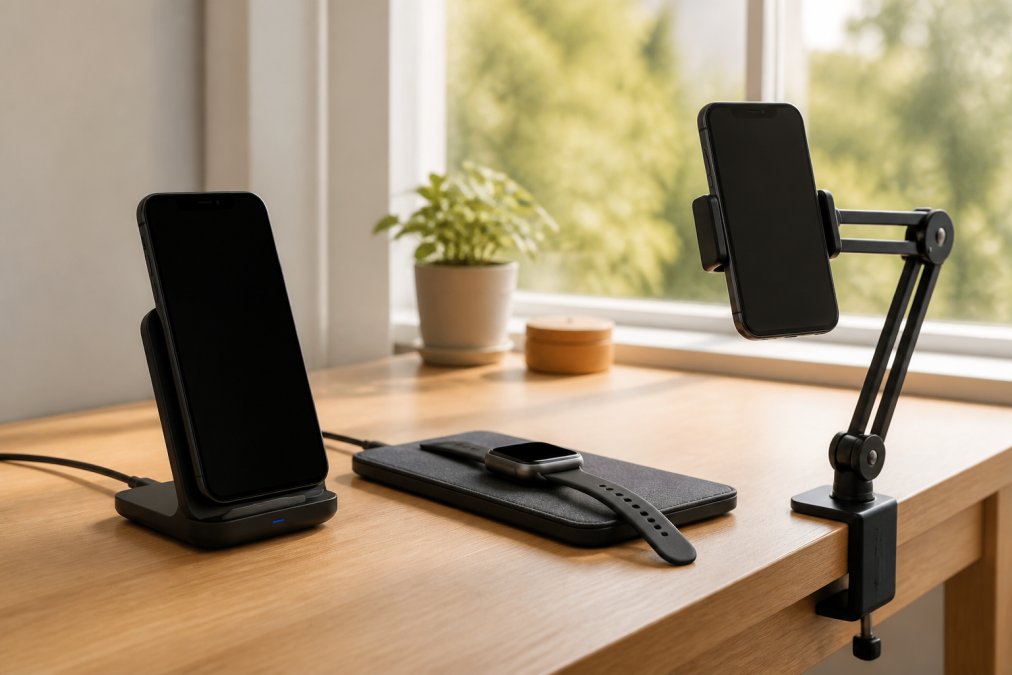
A flat charging mat is the most versatile option. It works with any Qi-compatible device regardless of orientation, accommodates multiple small devices simultaneously, and sits low on the desk. You can't easily view your screen while charging.
A wireless charging stand holds your phone upright at a viewing angle, ideal for video calls, notifications, or using your phone as a desk clock. Many stands support both portrait and landscape orientation.
A desk mount or clamp-style charger attaches to your desk edge or monitor arm and keeps your phone at eye level while charging. These are popular with streamers and content creators who need their phone visible and powered throughout a session.
Case Compatibility and Thickness Requirements
Case thickness is the most common source of wireless charging frustration. The electromagnetic field that transfers power weakens with distance, and most Qi chargers have an effective range of 4-8mm from the charging coil surface. Standard slim cases fall well within this range. Heavy-duty rugged cases, wallet cases with metal card slots, and cases with integrated kickstands often do not.
Metal components inside a case are a particular problem. They can block the electromagnetic field entirely or trigger the pad's foreign object detection, stopping the charge. If your case includes a metal plate for magnetic car mounts, wireless charging will likely fail. Either switch to a Qi-compatible case or remove your case before placing the device on the pad.
Long-Term Battery Health, Safety Features, and Eco-Friendly Materials
Wireless charging generates more heat than wired charging, and heat is the primary accelerant of lithium-ion battery degradation. A well-designed Qi-certified pad includes thermal protection that throttles charging speed when the device or pad surface temperature rises above a safe threshold.
Charging to 100% and leaving your device on the pad overnight compounds heat exposure. Many current smartphones include optimized charging modes that learn your routine and slow the final charge to reduce heat exposure during overnight sessions. Enable this feature regardless of which pad you use.
Some manufacturers now use recycled plastics, plant-based composites, and minimal packaging in their charging pads. These products carry the same Qi certification as conventional alternatives.
Desk Setup Integration, Cable Management, and Troubleshooting Charging Failures
Wireless charging pads reduce cable clutter significantly. Every pad still requires a power cable to the wall, but that cable terminates at the pad, not at your device. For a clean desk setup, run the pad's USB-C cable through a cable management channel or under a desk mat. Multi-device docks that consolidate three charging zones into one cable connection are the most effective cable reduction solution available.
Common Charging Failures and How to Fix Them
Device not charging at all:
- Check device alignment over the charging coil. Move the device slowly across the pad surface until charging initiates.
- Remove the case. Metal components or excessive thickness may be blocking the charge.
- Verify the power adapter is plugged in and the USB-C connection to the pad is secure.
Charging slower than expected:
- Confirm your power adapter wattage matches the pad's requirements. A 15W pad on a 5W adapter will charge slowly.
- Check that your device supports the pad's maximum wattage.
- Disable any battery saver modes that limit charging speed.
Pad stops charging mid-session:
- Thermal protection has likely triggered. Allow the pad to cool, then resume.
- Check for foreign objects between the device and the pad surface.
Intermittent charging:
- Non-slip surface degradation can allow the device to drift off the coil. Clean the pad surface or replace it if worn.
- LED indicator behavior can help diagnose: most pads use a steady light for active charging and a blinking light for errors.
Where to Buy Wireless Charging Pads Online: What Sets a Good Retailer Apart
The decision to buy wireless charging pads online comes down to three things: product authenticity, shipping reliability, and support when something goes wrong.
Counterfeit and uncertified wireless chargers are a genuine problem in the online marketplace. The safest approach is to purchase from retailers who explicitly verify Qi certification for every product they carry and who stand behind their inventory with clear return policies.
Esther Tech Shop ships every order within 24-48 hours, carries secure and reliable payment options, and offers customer service Monday through Saturday, 9 a.m. to 8 p.m., so questions about compatibility or returns get answered by a real person, fast. Customers like Chris M. from New York noted that support replied in under an hour, and Laura R. from Chicago described the shopping experience as "fast, safe, and hassle-free."
The compatibility question is one we take seriously. Detailed product specifications and attentive pre-purchase support make the difference between a curated tech retailer and a generic marketplace.
Finding the right wireless charging pad is harder than it should be, given how many uncertified products crowd the market and how few guides address long-term battery health or real compatibility requirements. Esther Tech Shop curates high-quality, Qi-certified wireless charging accessories with guaranteed 24-48 hour shipping, secure payment options, and attentive customer support available six days a week. Continue shopping at Esther Tech Shop and get a desk setup that charges every device reliably, without the cable tangle.
Frequently Asked Questions
What should I look for when buying a wireless charging pad?
Focus on four things: certification, speed, design, and safety features. Look for Qi-certified or Qi2 standard pads to ensure universal compatibility. Check the wattage output, 15W fast wireless charging covers most flagship phones, while some Android devices support higher wattage. Choose between a flat charging mat, an upright stand, or a multi-device dock based on your desk setup. Thermal protection, foreign object detection, and over-voltage protection are safety features worth confirming before you buy wireless charging pads online.
Are all wireless charging pads compatible with all phones?
No. All Qi-certified pads work with Qi-enabled phones, but charging speed varies by device. A 15W fast wireless charging pad will only deliver full wattage to phones that support that output, others charge at a lower rate. MagSafe-compatible pads require an iPhone 12 or later for magnetic alignment and maximum speed. Qi2 standard pads offer magnetic alignment similar to MagSafe and work across a broader range of devices. Always check your phone's supported wireless charging wattage before purchasing.
What is the fastest wireless charging pad available?
Charging speed depends on both the pad's wattage output and your device's supported input. Most flagship iPhones top out at 15W with MagSafe. Many Android flagships support 15W or higher through Qi-certified fast wireless charging pads, with some proprietary systems exceeding 25W. Qi2 standard pads currently deliver up to 15W with improved device alignment for more consistent charging efficiency. A pad rated above your device's maximum will not charge faster, matching wattage to your device matters more than buying the highest number.
How do I know a wireless charging pad will work with my phone case?
Most Qi-certified and Qi2 wireless charging pads work through cases up to about 3mm thick. Thicker cases, metal cases, or cases with built-in card slots can block the electromagnetic field between the charging coil and your phone, causing slow or failed charging. MagSafe-compatible cases use magnetic alignment to maintain precise device alignment regardless of minor thickness. If you use a thick or rugged case, check the pad's listed case compatibility or look for a model with a stronger charging coil rated for thicker materials.
Is it safe to buy wireless chargers online, and what guarantees should I expect?
Buying wireless charging pads online is safe when you purchase from a retailer that stocks Qi-certified products and offers clear return policies. Look for shops that provide secure payment processing, transparent shipping timelines, and accessible customer service. Qi certification from the Wireless Power Consortium means the charger has passed standardized safety tests covering thermal protection and over-voltage protection. Avoid uncertified chargers sold at unusually low prices, as they may lack foreign object detection and other safety circuits that protect your device.
This article was written using GrandRanker