 ultimate-guide
Why Use Wireless Charging Pads: Benefits & Buyer Guide
Table of Contents
- What Is Wireless Charging and How Does It Work?
- Key Advantages of Wireless Charging Pads
- Does Wireless Charging Ruin Battery Health?
- Wireless Charging Speed vs. Wired: What's the Real Difference?
- Disadvantages and Trade-Offs to Consider
- How to Choose a Wireless Charger for Your Needs
- Conclusion
Last Updated: August 17, 2026
What Is Wireless Charging and How Does It Work?
Wireless charging pads enable you to power your devices without plugging in a cable. Instead of connecting a USB port, you simply place your phone, smartwatch, or earbuds on a charging surface, and power transfers through the air. This technology relies on electromagnetic induction, a principle where electrical current flowing through a coil creates a magnetic field that induces current in a receiver coil inside your device.
The process works through two main components: a transmitter coil built into the charging pad and a receiver coil embedded in your device. When you activate the pad, the transmitter generates an alternating magnetic field. The receiver coil detects this field and converts it back into electrical current, charging your battery. The most common standard governing this technology is the Qi standard, an open protocol that ensures compatibility across thousands of devices and manufacturers.
Distance matters, but not as much as alignment. Most wireless chargers work effectively within a range of a few millimeters to about half an inch, depending on the pad's power output and your device's receiver coil placement. This is why positioning your phone correctly on the pad makes a real difference, misalignment reduces charging efficiency and can generate unnecessary heat.
At Esther Tech Shop, we carry wireless charging solutions designed to work seamlessly with your existing devices. Our Three-in-One Magnetic Wireless Charger uses the Qi standard and delivers 9V/2A output, making it compatible with iPhones, Android phones, smartwatches, and wireless earbuds. Understanding how electromagnetic induction powers your devices helps you appreciate why wireless charging pads have become standard in modern tech setups.

Key Advantages of Wireless Charging Pads
The most immediate benefit of wireless charging pads is convenience. You eliminate the friction of hunting for cables, untangling cords, or fumbling with connectors in the dark. Place your phone on the pad and it charges, no plugging required. For people managing multiple devices throughout the day, this small friction reduction compounds into meaningful time savings.
Reducing cable clutter on your desk or nightstand is a tangible quality-of-life improvement. Remote workers and content creators especially appreciate cleaner workspaces. Fewer cables mean fewer tangled messes, less visual distraction, and more desk real estate for actual work. A single wireless charging pad replaces what might otherwise be three separate cables for phone, smartwatch, and earbuds.

Wireless charging pads extend the lifespan of your charging port. Traditional wired charging involves repeated mechanical stress: inserting connectors, removing them, the wear and tear that accumulates over months. Your charging port is a physical interface that degrades with use. By switching to wireless charging for daily top-ups, you reduce the number of times you use that port, preserving it for situations where wireless charging isn't available. This is particularly valuable for expensive devices where port replacement is costly.
Multi-device charging is another significant advantage. A three-in-one charging stand lets you power your phone, smartwatch, and earbuds simultaneously from a single power adapter. This consolidation reduces the number of adapters cluttering your space and simplifies your charging routine. Our 3 in 1 Wireless Charger Stand for iPhone does exactly this, charging three devices at once without requiring separate cables.

The universal compatibility of Qi-standard chargers means you're not locked into proprietary ecosystems. Whether you own an iPhone, Samsung Galaxy, Google Pixel, or any Qi-compatible device, the same pad works. This flexibility matters when you upgrade phones or use multiple devices across different brands.
Does Wireless Charging Ruin Battery Health?
This concern appears frequently in online discussions, but the answer is nuanced. Wireless charging doesn't inherently damage your battery more than wired charging does, the battery degradation comes from heat and charge cycles, not the charging method itself.
Heat management is the real variable. Wireless charging generates more heat than wired charging because electromagnetic induction is less efficient. Energy loss during the power transfer process converts to thermal energy. If your device gets hot during wireless charging, that heat accelerates battery degradation over time. However, most modern devices and chargers include thermal management systems that regulate temperature and slow charging speed if things get too warm.
The key distinction: a well-designed wireless charger with proper thermal management won't harm your battery more than wired charging. A poorly designed one that lets your phone get hot during every charge session will degrade your battery faster. This is why charger quality matters. Our products are engineered with thermal considerations in mind, ensuring your device charges safely without excessive heat buildup.
Charging speed also affects battery health indirectly. Slower charging generates less heat and puts less stress on battery chemistry. Wireless charging is inherently slower than fast-wired charging (typically 5-15W versus 20-65W for modern wired fast chargers), which actually works in your battery's favor over the long term. If you use wireless charging for daily top-ups and reserve fast wired charging for urgent situations, you're optimizing for battery longevity.
Charge cycles are what truly matter. Every time you charge your battery from 0-100%, that counts as one cycle. After hundreds of cycles, battery capacity naturally diminishes, this happens with any charging method. Wireless charging doesn't create additional cycles; it just delivers power differently. If you're charging your phone once per day whether wirelessly or wired, you're accumulating the same number of cycles.
Wireless Charging Speed vs. Wired: What's the Real Difference?
Wired charging is faster, and the numbers are clear. A typical wireless charger delivers 5-15W of power. Modern wired fast chargers deliver 20-65W or more, depending on the device and adapter. This means a wired charger can fill your battery in roughly half the time of a wireless charger.
But speed isn't the only metric that matters. Charging efficiency tells a different story. Wireless charging loses energy during the electromagnetic power transfer, typically 10-20% of the energy is lost as heat. Wired charging is more efficient, delivering more of the energy from the wall directly to your battery. If you care about electricity costs or environmental impact, wired charging is more efficient.
The practical reality for most users: wireless charging is fast enough for overnight charging or desk charging during work hours. You're not waiting hours for a full charge; you're waiting perhaps 2-3 hours instead of 1-1.5 hours. For daily use, this difference is negligible. Where wired charging wins is emergency top-ups, if your battery drops to 5% and you need 50% charge in 15 minutes, wireless charging won't cut it.
Energy waste is worth considering. Wireless chargers consume standby power even when not actively charging a device, and the charging process itself wastes energy as heat. If environmental impact concerns you, wired charging is the more efficient choice. However, the difference in your electricity bill is minimal unless you're charging multiple devices wirelessly several times per day.
Our 15W Magnetic Wireless Charger Mouse Pad delivers solid charging speed for a desk setup, 15W is at the higher end of wireless charging output. This still won't match a 45W wired charger, but it's more than adequate for maintaining your phone's charge throughout the workday.

Disadvantages and Trade-Offs to Consider
Alignment sensitivity is a real limitation. Your device must be positioned correctly on the charging pad for efficient power transfer. Misalignment reduces charging speed and increases heat generation. Some pads have larger charging zones that are more forgiving, but precision matters. If you're the type to toss your phone onto a nightstand without thinking about placement, wireless charging requires a slight behavior adjustment.
Case compatibility creates friction for some users. Thick cases, metal-reinforced cases, or cases with magnetic attachments can interfere with wireless charging. Some materials block or reduce the electromagnetic field transmission. You might need a thinner case or remove your case entirely for reliable charging. This negates some of the convenience advantage, you're back to fiddling with your phone to make charging work.
Wireless chargers require dedicated power adapters and take up desk or nightstand space. A charging pad is a physical object that occupies real estate. If your space is already cramped, adding a pad might not be practical. You also need to position it somewhere accessible, which means running a power cable to that location. In some setups, this creates a different kind of cable clutter.
Charging speed limitations matter if you're someone who needs rapid battery recovery. If you regularly find yourself at 5% battery and needing to leave in 10 minutes, wireless charging won't serve you. You'll still need a wired fast charger for those situations. Wireless charging is best for planned, predictable charging scenarios, overnight, at your desk, in your car, not emergency top-ups.
Heat generation during wireless charging can be higher than wired charging, particularly with cheaper chargers or when your device is misaligned. Excessive heat during charging sessions isn't ideal for long-term battery health, though modern devices manage this with thermal throttling. Still, if you notice your phone getting warm while wireless charging, it's worth investigating whether the charger or case is the culprit.
How to Choose a Wireless Charger for Your Needs
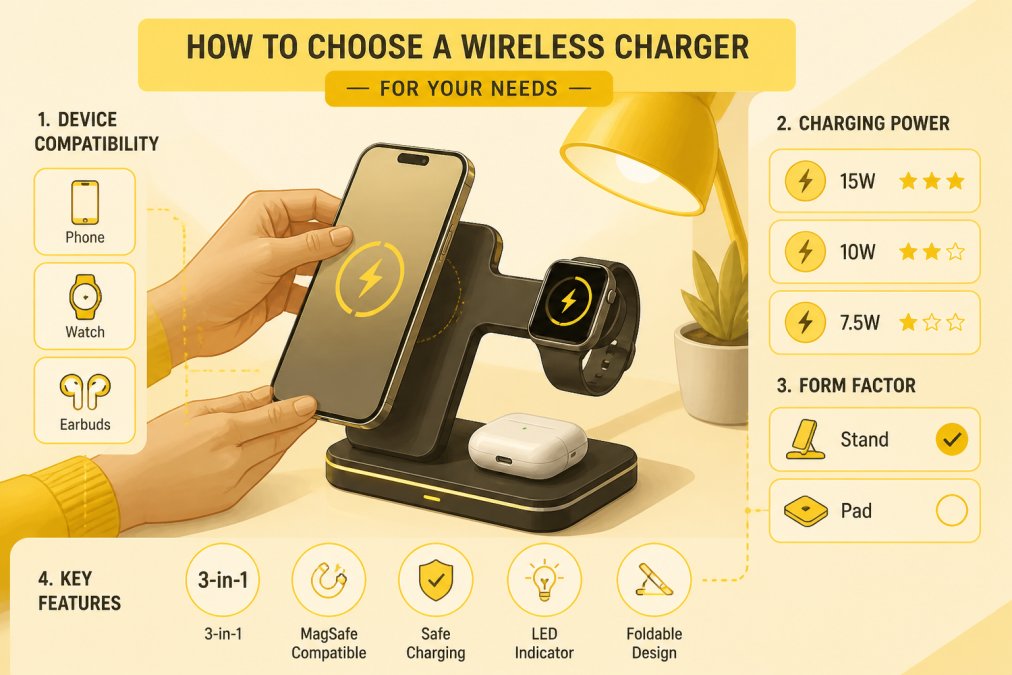
Start by identifying which devices you need to charge. Do you have just a phone, or are you managing a phone, smartwatch, and earbuds? Single-device chargers are simpler and cheaper, but multi-device stands offer better value if you own several Qi-compatible devices. This decision shapes everything else.
Check your device's charging specifications. Not all devices support wireless charging, older phones and budget models often lack a receiver coil. If your phone supports wireless charging, verify its maximum wattage. An iPhone typically supports 15W wireless charging, while some Android phones support 20W or higher. Matching your charger's output to your device's capability ensures optimal charging speed without wasting money on excess power.
Case compatibility deserves attention before purchase. If you use a thick case or metal-reinforced case, test wireless charging with it on before committing. Some cases are wireless-charging-friendly; others aren't. If you're buying a new charger specifically because your current case blocks charging, consider whether a thinner case might solve the problem more cheaply than a new charger.
Consider your physical space and charging habits. Where will the charger live? Your nightstand, desk, car, or kitchen counter? Chargers designed for desks often have stands that angle the phone for visibility. Nightstand chargers prioritize compact footprints. Car chargers need dashboard or air-vent mounts. Match the form factor to your actual use case.
Look for chargers with thermal management features. Quality chargers include temperature sensors and circuit protection that prevent overheating. This is a feature worth paying for, it directly impacts long-term battery health. Cheaper chargers sometimes lack these safeguards, and your device pays the price.
Charging speed matters less than most people think, but it's worth understanding. A 5W charger is fine for overnight charging. A 10-15W charger is better for desk use where you want faster top-ups. Anything above 15W for wireless charging is overkill for most users, wired fast charging is better if speed is critical.
At Esther Tech Shop, we offer curated wireless charging solutions that balance quality, compatibility, and value. Our products ship within 24-48 hours, and our customer service team can answer specific compatibility questions if you're uncertain about your device. Michael A. from Miami shared: "I've already placed three orders and everything was perfect. Great quality, excellent service, and fair prices." That kind of reliability matters when you're investing in accessories for your daily workflow.
| Charger Type | Best For | Charging Speed | Space Required | Price Range |
|---|---|---|---|---|
| Single-device pad | Minimalists, occasional users | 5-10W | Small | Budget-friendly |
| Multi-device stand | Remote workers, multiple devices | 10-15W per device | Medium | Mid-range |
| Desk-integrated charger | Always-on desk setup | 10-15W | Medium | Mid-range to premium |
| Car mount charger | Commuters, road trips | 5-10W | Small | Budget to mid-range |
Wireless charging pads solve a real problem: cable clutter and charging port wear. They're not perfect, they're slower than wired fast charging, they generate heat, and they require proper alignment. But for daily charging in predictable scenarios, they deliver genuine convenience. The technology has matured enough that quality chargers from reputable brands are reliable and safe for your devices.
The decision comes down to your specific situation. If you work from a desk, charge overnight, or manage multiple devices, wireless charging is worth the investment. If you're constantly on the move and need rapid battery recovery, wired fast charging remains essential. Most people benefit from having both: wireless for routine charging and a wired fast charger for emergencies.
Esther Tech Shop carries wireless charging solutions designed for professionals who value quality and reliability. Whether you need a three-in-one stand for your desk or a magnetic charger for your workspace, our products are built to last and ship fast. Explore our wireless charging collection and find the right solution for your setup. With 24-48 hour shipping and customer service available Monday to Saturday, 9 a.m.-8 p.m., getting the right charger is straightforward. Continue shopping and upgrade your charging experience today.
Frequently Asked Questions
What's the main benefit of using a wireless charging pad over a cable?
The primary benefit is convenience and reduced cable clutter. Wireless charging pads eliminate the need to plug in cables repeatedly, which reduces wear and tear on charging ports and keeps your desk organized. You simply place your device on the pad and charging begins automatically. For busy professionals managing multiple devices, this hands-off approach saves time and extends the lifespan of your device's connector.
Does wireless charging damage your phone battery over time?
Wireless charging does not inherently damage your battery more than wired charging. However, heat management matters. Quality wireless charging pads use thermal management technology to prevent excessive heat buildup, which can degrade battery health. Modern devices and chargers are designed to work together safely. The key is choosing a reputable charger that maintains proper temperatures and avoiding cheap, unregulated options that may generate excessive heat.
Is wireless charging slower than traditional wired charging?
Yes, wireless charging is generally slower than wired charging. Standard wireless chargers deliver 5-10 watts, while fast-charging wired cables can deliver 18-65 watts depending on the device. However, modern wireless chargers now offer 15-watt fast charging options that significantly close the gap. For overnight charging or desk use during work hours, this speed difference is negligible. The trade-off between speed and convenience depends on your usage patterns.
Do you need a specific case to use a wireless charging pad?
Most wireless charging pads work through thin cases made of plastic, rubber, or fabric. However, thick cases, metal cases, or cases with magnetic attachments can interfere with the magnetic field and prevent charging. When selecting a wireless charger, check compatibility with your specific device and case material. If you use a thick or protective case, verify that your charger explicitly supports it, or consider a case designed for wireless charging compatibility.
This article was written using GrandRanker